 Summary
Youngest son in the family, with four brothers and five sisters. Brought
up by his mother as a widow. Started work as a porter and progressed to
become a commercial traveller. Then served in the Post Office for about 37
years, until enlisting and serving in India. He died shortly after his
return.
Parents and family
The 1881 Census has only one Arthur BULL born in St Pancras within 2 years
of 1868. He is the son of Amelia and Frederick BULL. There is only
one birth registration in that period for an Arthur Henry Frederick BULL
anywhere in the country and that is in St Pancras. It therefore seems
almost 100% certain that is the registration of Arthur's birth. That
certificate gives his father as
Frederick
Henry
William BULL, Commercial Traveller, and his mother as
Amelia
BULL
formerly GAYWOOD.
Arthur's wedding certificate gives his father as Henry William
Frederick BULL, Commercial Traveller. However, transposition of forenames
and even the clear use of false forenames occurs elsewhere amongst the
records for this family.
Birth
He was born on 21 May 1867 at 5 London Street, St Pancras, London. The
birth registration (Sept Q 1867, Pancras, 1b, 31) states that he was
Arthur Henry Frederick BULL, son of F. H. W. BULL, Commercial Traveller,
and Amelia BULL formerly GAYWOOD.
Childhood and education
Arthur was the son of a commercial traveler but appears to have lost his
father in the year that he was born.
The 1871 Census has his family at 8 Park Street, (adjacent to Regents
Park), Marylebone, London. At that time it comprised -
- Amelia BULL, Head, Widow , 43, Annuitant / Monthly Nurse,
Essex, Hornchurch
- Frederick BULL, Son, , 18, Horsekeeper, Middsx, Camden
Town
- Harry BULL, Son, , 14, Errand Boy, Middsx, St Pancras
- Adolphus BULL, Son, , 9, Scholar, Middsx, St Pancras
- Minnie BULL, Daur, , 7, Scholar, Middsx
- Frank BULL, Son, , 5, Scholar, Middsx
- Arthur BULL, Son, , 3, , Middsx
Employment
The 1881 Census shows the family at 24 Paradise St, St Pancras,
London, Middlesex. At which time it comprised -
- Amelia BULL, Head, W[idowed], 55, Monthly Nurse, Essex, Hornchurch
- Adolphus BULL, Son, U[nmarried], 20, Coach Painter Mechanic,
Middlesex, St Pancras
- Frank H. BULL, Son, , 15, Porter, Middlesex, St Pancras
- Arthur BULL, Son, , 13, Porter, Middlesex, St Pancras
- Charles EVERARD, Other, W[idowed], 49, Coach Painter, Middlesex,
Hackney
Charles EVERARD's relationship was somewhat unusually described as
'other'. EVERARD seems to have taken Adolphus under his wing as they share
their occupation.
Arthur joined the Post Office. In Feb 1891 the appointment of one Arthur H
BULL at Woodford Green is listed in the British Postal Service Appointment
Books. (British Postal Museum and Archive; Series:
POST 58; Reference
Number:
91.).
In February 1891 Arthur H BULL was appointed as a postman at Woodford
Green
The 1891 Census lists him as aged 23, named Arthur H F BULL and born in
St Pancras. He is living at 6 High Beech Road, Loughton, Essex, where he
is a boarder with his wife-to-be and several of her children
and another boarder from Newmarket, Cambs.
- Lavinia M MCINTOSH, Head, Wid[ow], 32, needlewoman shirt, Somerset,
Castle Cary
- Alicke, Son, 10, Scholar, Surrey, Guildford
- Violet, Daughter, 9, Scholar, Surrey, Guildford
- May, Daughter, 5, Scholar, Surrey, Guildford
- Frederick S. WRIGHT, Boarder, 23, Print Agent Assist &
Journalist', Cambs, Newmarket
- Arthur H. F. BULL, Boarder, 23, Postman's Mess, London,
St. Pancras
This census shows Arthur employed as a postman's messenger. This was to be
the start of a career in the Post Office (so there is probably information
waiting to be found at
The
British Postal Museum & Archives).
Marriage to Lavinia McIntosh
On 30 May 1892, at the Registry Office in the district of Epping, he
married
Lavinia Maria
MCINTOSH (nee Curtis, widow of John Allen MCINTOSH). The
marriage certificate gives the following details -
Groom: Arthur Henry Frederick Bull, aged
24, batchelor, Postman, residing in Staples Road, Loughton, Essex.
Father Henry William Frederick Bull (deceased), commercial traveller.
Bride: Lavinia Maria Mackintosh [but signed McIntosh], aged 34, widow,
resident of High Beech Road, Loughton, Essex. Father Henry Curtis,
gardener. Witnesses: John E Guy, Ina H Ward, Annie Florence Guy.
Married life
In 1893 a son called Arthur Henry F BULL appears to have been born as BMD
indexes show a birth under this name was registered in the June Quarter in
Epping, Essex. The family recall an Arthur BULL who died in infancy.
On the 4 Feb 1895 his daughter
Ivy
Lavinia BULL was born in Loughton, Essex. Ivy married
Ernest
Henry HICKS in 1028 in Loughton Essex. At that time his occupation
is described as “Letter Carrier.”
In 1897 a son called Harold Victor BULL appears to have been born as BMD
indexes show a birth under this name was registered in the June Quarter in
Epping, Essex.
In 1898 Harold Victor BULL appears to have died. BMD indexes show a death
under this name, aged 1, under the June Quarter of 1898. The family recall
an Harold BULL who died in infancy.
In 1898 Arthur Henry F BULL also appears to have died. BMD indexes
show a death under this name was registered in the June Quarter in Epping,
Essex. He would have been about 6.
On 30 Sep 1899 Gladys Evelyn BULL was born , she later married Walter
COLLINSON (b.1908 - d.1997). She died in 1997 in Bognor Regis, West
Sussex, a few months after her husband.
The 1901 Census has him living at High Beech Road, at which time the
family comprised:
- Arthur H. F. BULL, Head, M[arried], 3[2 or 3], Town
Postmaster, Worker, London, St Pancras
- Levenia M. BULL, Wife, M, 40, , , Somerset, Castele Cary
- Wallaciana MCINTOSH, Step Daur, , 14, , , Surrey, Guildford
- Ivy Levenia BULL, Daughter, , 6, , , Essex, Loughton
- Gladys E. BULL, Daur, , 1[6 or 8] mo, , Essex, Loughton
On 26 March 1910 his step-daughter Violet married William Rock MURRAY.
| Arthur and Lavinia (seated) are on the
right. Their daughters Gladys and Ivy are the bridesmaids and look
about 10-12 and 15-17 respectively. The girl's age dates this
picture to around the time of Violet MCINTOSH's wedding and so I
believe that this picture is probably of that marriage. Arthur is
on the groom's side even though the bridesmaids are his
daughters. |
 |
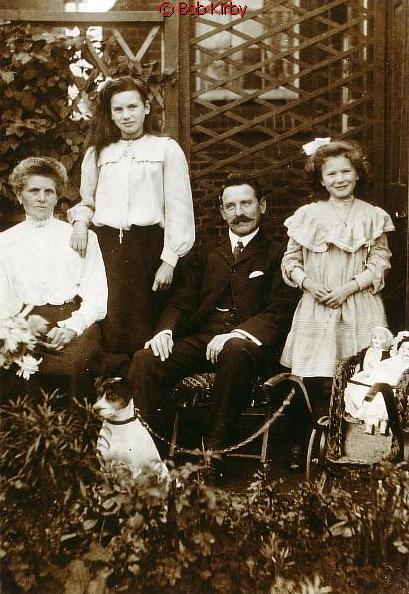
| This family group
picture date from around the same period as the wedding group
shown above. Probably in the garden at 5 Forest Green, as they had
already moved there by 1915, and a later picture shows Arthur in
military uniform in the same garden. |
 |
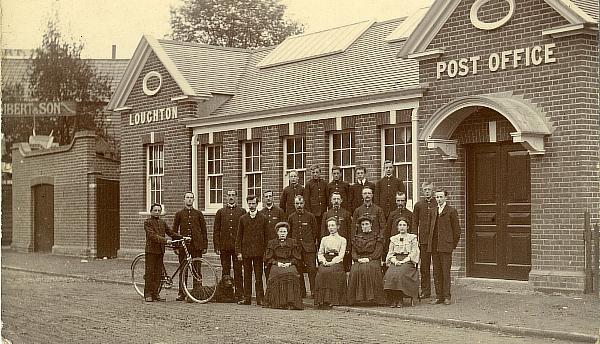
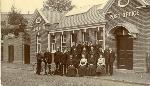
In 1908 the Loughton Post Office moved to new premises in Forest Road.
In 2026 the building still existed, but as a Wetherspoons establishment
called 'The Last Post'. The following staff group, which includes
Arthur, was probably taken at about that time, given the way it
showcases the new office.
| Post Office staff outside the Forest Road
Office |
 |
The 1911 Census shows the family a 6 High Beech Road, Loughton, Essex.
At that time the family comprised:
- Arthur H F BULL, Head, 43, Married, Town Postman, St Pancras, London
- Lavinia Maria BULL, Wife, Married, [for] 19 [years],, Castle Carey,
Somerset
- Ivy Lavinia BULL, Daughter, 16, Single, , Loughton, Essex
- Gladys Evelyn BULL, Daughter, 11, Single, , Loughton, Essex
- Percy R BIRD, Lodger, 20, Single, Postmasters Assistant, Rendham,
Suffolk
The first world war
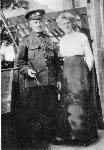
By the time of the first world war, Arthur would have been in his fifties.
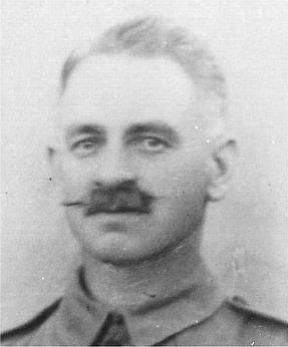
According to his obituary (below), Arthur volunteered in 1914, and served
three and a half years in India. There is a picture of him in military
uniform, a copy of which is annotated ' National Reserve 1915'. The cap
badge is a shield within a circle, surmounted by a crown, and closely
resembles that of the Essex Yeomanry, a Reservist unit. C Squadron of the
Essex Imperial Yeomanry (later the Essex Yeomanry) was based in Forest
Road, Loughton, in a drill hall built in 1900. In 1908, under the Haldane
reforms, the Yeomanry were subsumed into the Territorial Force. Later
evidence suggests Arthur served as part of the Territorial Force during
WWI (see below).

Documentation connected to the award of his British War Medal
provides an overview of the regiments he served in and his rank. An
entry in the listing for "Rifle Brigade. (TF)." in the 1919 Register
of Individuals Entitled to the British War Medal is particularly
revealing, and through the inclusion of the individual's date of death,
confirms conclusively that it refers to him. The title of the listing
confirms that he served within the Territorial Force branch of the Rifle
Brigade.
206773; rank Rfm. [Rifleman]; BULL
Arthur H.F.; previously served in 24/Rif. Brig. Rfm.702, theatre of
war India; 12.2.16 to 17.3.19. Died 4.6.19. Annotated Rt'd nl 743
K.R. CRV46/13/B. all 723 Authy 7956/asr.
This record also corroborates the period of 3.5 years that his
obituary claimed he served in India. The basic details of the above
record are confirmed by his medal card itself.
BULL Arthur H F
Corps: Rif. Brig, Rank: Pte, Regtl. No.: 702;
Corps: -do-, Rank: [blank], Regtl. No.: 206773;
Medal: British, Roll: TP/105 A/a, Page.:110 [indicating that he
rendered approved service overseas]
There are some remarks, but they are hard to decipher, something
like "Retd(1743 Kb)7956/Asr"
At the bottom right the card is annotated 7956/Asr
The relatively low regimental number indicates an early recruitment.
It is fairly normal for soldiers who served in Europe during WW1 to get
both British War and Victory medals, but it seems that, if a soldier
served in a garrison in India he would normally get only the British War
Medal. The abbreviation 'Retd' was used when the medal was returned for
some reason, e.g. if the recipient had moved house, or could no longer
be traced.
Through the existence of the territorial Post Office Rifles, there
had long been an association between the Post Office and the Rifle
Brigade. The service number 702 was a regular Rifle Brigade service
number and, based on a site dating the number ranges, he would have been
given it c. 1890-91 or c. 1904-05. As Arthur appears to have been
working for the Post Office during both these periods it is possible
that he was originally allocated this lower Service Number as a
reservist.
It is fairly normal for soldiers who served in Europe during WW1 to
get both British War and Victory medals, but it seems that, if a
soldier served in a garrison in India he would normally get only the
British War Medal. The abbreviation "Retd" was used when the medal was
returned for some reason, e.g. the recipient had moved house, or in
protest.
A directory published in 1915 lists an Arthur H BULL at 5 Kings green,
High Road, Loughton.( London Metropolitan Archives; London, England;
London City Directories. Pg 289). This suggests that his initial service
was undertaken near to home. It is, therefore, likely that Arthur
initially joined a territorial force linked to the Essex Regiment (his cap
badge seems in keeping with that).
 |
The cap badge is not clear, but its overall features point with
reasonable certainty to the Essex Regiment (wreaths on either
side; a taller central element, topped by an asymmetric object,
projecting above the wreaths, and resembling a lion couchant
in outline; two parallel and shorter elements flanking the
central one, divergent downward pointing projections at the base,
a bit like the tails of a bow). It is clearly not the
distinctive cross-bearing badge of the Rifle Brigade. Closer
inspection of the scan reveals that the text could be "Raj Brig,"
which could stand for Indian Brigade. |
On 28 Nov 1915 the 4th (Home Counties) Battalion of the Rifle
Brigade's Territorial Force was formed from supernumerary TF Companies,
manned by National Reservists, who had, until then been guarding
potential targets at home. The 24th (Home Counties) Rifle Brigade was a
Territorial Force and drafted supernumerary men on the National Reserve,
taking men from several Regiments, including the Essex. The record of
the 24th is by far the most sparse of any of the Territorial Battalions,
and it was involved purely in Internal Security duties.
Between Nov 1915 and Feb 1916, Arthur presumably acquired his later
Rifle Brigade service number.
On 12 Feb 1916 Arthur began his service with the Rifle Brigade in
India, and would have arrived at Agra. The 24th (Home Counties)
Battalions Territorial Force was part of the 26th Reserve Brigade, along
with the 18th & 23rd Battalions. India supported Britain in the 1st
World War, and posts had to be maintained to defend its northern border.
The three Battalions were used for garrison duty at vulnerable points.
The 24th (Home Counties) Battalions Territorial Force moved to Sialkot,
on the plains of the Punjab (32.49N, 74.53E), and now in Pakistan, on 19
April 1916. They remained there until at least October 1918. A posting
on the Great War Forum (stiletto_33853, 29 March, 2010) noted that
detachments were, at different periods, sent to Jullundur, Amritsar,
Lahore and Ferozepore.
 |
The large 'tip-upward' chevron worn on the lower left sleeve of
this tunic is a good conduct badge. They were awarded to soldiers
of a rank below corporal and one stripe indicated two years good
service. They were only worn on the individuals service dress
tunic. The picture was taken in Nov 1917, at Sialkot, for
sending home. The 24th (Home Counties)
Battalion of the Rifle Brigade were stationed there at the time.
The leopard skin rug and lightweight uniform are consistent
with that. |
Arthur's daughter, Ivy, kept various mementos, including a notebook with
drawings and pressed flowers. Among its contents are a sprig of Maidenhair
Fern, an Ivy leaf, and a sprig of clubmoss, all labelled 'Kailana'.
Kailana Hill Camp was an
Army
Convalescent Depot and rest camp located on a hill
approximately 2.5 miles from Chakrata in
the Dehra Dun District, in northern India (30.6922N, 77.8488E).
It was common for units stationed on the hot plains to send individual
soldiers or detachments to cooler Kailana for "recuperation" or "hill
station duty"during the hottest months of the year. The floral samples are
consistent with the lush Himalayan foothills in which Kailana was set.
0n 6 March 1919 the situation of the 24th Battalion prompted a
question in Parliament, from Mr Cautley who"asked the Secretary of State
for War whether he is aware that the 24th Battalion of the Rifle Brigade
has been in India for more than three years; that it is composed mainly
of men voluntarily enlisted at or immediately after the commencement of
the War; and that it contains between 400 and 500 men over forty-one
years of age, of whom the majority are over forty-five, many over fifty,
and some even over sixty years of age; is he aware that the large
majority of these men are married and have families and that a
considerable number have situations at home that have been kept open for
them; and whether, in the interests of justice, he can take immediate
steps to bring these men home before the hot season commences?" Hansard
HC Deb 06 March 1919 vol 113 cc642W
A ROLL OF INDIVIDUALS entitled to the British War Medal granted
under Army Orders 266. for the RIFLE BRIGADE. (TF)., dating from
1919, provides some further detail including the precise date on which
his service ended.
206773 [rank] Rfm. BULL, Arthur H.F. 24/Rif. Brig.Rfm.702.
[Theater of war] INDIA 12.2.16. to 17.3.19. Died.4.6.19.
The record of what happened to the medal is hand-written in red as Retd
n1743 K.R.CR146/B d16.7.23 Authy 7956 /adt
Germany agreed to a cease fire on 11 November 1918 (Armistice Day), but
Arthur did not finish his service in India until to 17 March 1919. His
obituary suggests he returned only a few weeks before he died, so possibly
in May 1919.
Last Will and Testament
The details of his will are not known, but probate was granted on 25 Aug
1919. The National Probate Calender gives the following details
BULL Arthur Henry Frederick of 5
King's Green Loughton
Essex died 4 Jun 1919 Administration London 25 August
to Lavinia Maria Bull widow. Effects £302 13s. 3d.
Death
On 4 June 1919. The registration ref. is June Q, 1919, Bull, Arthur H
F, age 52, Epping, 4a, 325.
Arthur returned to a UK still grappling with the Spanish Flu pandemic
and, according to one obituary he "died from heart failure following
influenza and pleurisy, after only a fortnight’s illness." Another
states he "died peacefully in his own bed with his beloved family round
him" (see full texts below). Death statistics for the 1918-19 Spanish
Flu pandemic were kept, in the UK, up until 10 May 1919.
In the scrap-book kept by his grand-daughter Pamela Kirby (nee Hicks)
is an newspaper article, of uncertain origin, detailing his funeral. The
text is reproduced below.
Funeral
of Mr A Bull.
On Saturday last the funeral of the late Mr A. Bull, whose death was
reported in last week’s issue, took place at the Cemetery. The chief
mourners were : the widow, son, and five daughters; the Postmasters of
Loughton and Woodford Green, Mrs A Basham (late Postmistress of
Loughton), his fellow-collegues the postmen of Loughton, Mr W.E.
Stevens (President, Loughton Brotherhood); Mr L. A. J. Hutchin, and a
large number of Brotherhood men, to which body the deceased was
attached; Rev W. S. Lord (late of the Union Church), Mr Geo. Perry, Mr
H.G. Parker (who served with the deceased on active service in India),
and many neighbours and friends by whom the deceased will long be
remembered. The floral tributes were very choice and were as follows:
From the bereaved family to dear father; with loving wished from Netta
and Alick to dear father; sincere sympathy from the Postmaster and
Staff, Loughton Post Office; sincere sympathy from the Postmaster,
Woodford Green; sincere sympathy, Mrs Hind, High Beech; a token of
deepest sympathy from the neighbours, Mr & Mrs Shingleton, Mr
& Mrs Cheek, Mr & Mrs Austin; From all at Louisa Villle; Mr
and Mrs Neville & family; with deepest sympathy, the Loughton
Brotherhood; with deep regret and sincere sympathy from Questcot, “He
too has died that England may live”; Mrs Bowditch, Miss E. Bowditch,
and staff (B. Clark, M. Poulter, and O. Hawkins); with kind and
faithful remembrances of our dear Mr Bull, from S. K. C. and C. F. C.;
with deep sympathy from Mrs Bailey; Mrs Butler Harris with sympathy;
and others — The first portion of the service was conducted at the
home of the deceased and the remainder at the graveside, by the Rev H.
J. Wicks D.D. The interment took place in a family grave. — As
stated last week, Mr Arthur Bull died from heart failure following
influenza and pleurisy, after only a fortnight’s illness. Mr Bull was
52 years of age, and had been in the service of the Post Office for
about 37 years. He was well-known and greatly liked and respected in
Loughton, and his death comes as a great blow to his wife and family.
Mr Bull volunteered for active service in 1914, and served for
3½ years in India, having only returned 8 weeks ago. Mr Bull leaves 2
daughters, 3 step-daughters, and 1 step-son.
[The Loughton Brotherhood refers to the local Freemasons. The Neville
family may be the family of Ivy Bull's sweetheart who was killed in the
war]
Another newspaper clipping, again of uncertain origin, provides an
appreciation. The text is reproduced below.
| AN APPRECIATION |
[By a Member of the Brotherhood]
A veteran member of the Loughton Brother-
hood writes us an appreciation of the
deceased as follows: "Brother Bull was a
quiet, unassuming unit of our Movement in
Loughton; and if, in the meetings, he did
not take much active part, he always and
very persistently "did his bit" outside and
"ran the boys in" when and wheresoever
he could. He gave away no tracts, but,
believing in the super-influence of the hum
an voice, spoke the right word that made
the lads go willingly enough with him to the
Lincoln Hall. 'Not for a Pleasant Sunday
Afternoon,' he once said to a small collec-
tion of lads near the 'bus terminus, 'but to
a spiritual drilling for unsimple ways and
the wasting of Gods's valuable time!' For
Bull could never waste time; was a great
disciplinarian, as, in his official duties as a
humble postman, he wished to be discip
lined. Shirking work and 'milking' he
abhored like poison; and, in the midst of
so much that was claimed from him, I often
used to wonder how he could find time for
a hobby - bee-keeping and gardening. Yet
it is only such men as Arthur Bull who do
find time to work. He did nothing in a
hurry - excepting walking, oh! how he did
tear along something with those billet-doux
for the doorstep-waiting-damsels (he knew them
all, despite their assumed air of indifference
when handing them their missive!) - and so
did it well. Then the war came, and he
went away before conscription had to tell
others they had to go. Notwithstanding
his years, he was yet young in heart, body,
spirit. "A man is as old as he feels." and
"young Bull" felt that his place was with
the Colours, his duty for King and Country
The fact that, following a brief training, he
was sent straight to India, showed that the
military authorities quickly recognised yet
another man able, as he well proved it for
over three years, to stand the fierce heat of
the day, and the chill damps of the nights.
And borne so often in the open, when cam-
paigning up in the hills, far away from
European or even coastal civilization, that
the luxury of a bed, worthy of the name,
was an unknown quantity. As Bull told at
the Brotherhood, the last time I saw him
in the flesh, he had had his bouts of fever,
"and other bothering things." He was
never a man of illnesses and ailments ; but
as he admitted, "goes of fever do pull one
up some!" When, as he said to me, the
men succumbed out there, it was more often
chiefly due primarily to an already under-
mined constitution. What, undoubtably,
undermined Bull's constitution and led up
to his lamented death was not the climate of
India - he, and Perry and Parker, and
others, could stand that - but the vagaries
if our own climate. As I write, I think of
those many brave Indians who went into
Flanders in the dismal summer of 1916, to
die of cold ere they saw a German! When
Bull came back to England a few weeks
ago, it was to fight a worse enemy than a
few possible turbulent, German inclined na
tive tribes. When I told him on the Sun-
day afternoon that I did not think he looked
"over-grand," he admitted it! The fol-
lowing Sunday, at the Brotherhood, we al [sic]
heard Bull was "up against it." And so
worthy a much-liked man had "come
home from the war" and died peacefully in
his own bed with his beloved family round
him. That he will live long in the memory
of all others who knew him well, I have not
the least doubt. That he deserves a place
in the portrait gallery on the walls of Lin-
coln Hall, I have no doubt either. |
| LOUGHTON BROTHERHOOD |
The Loughton Brotherhood meeting at
Lincoln Hall on Sunday afternoon last was
well attended, Mr Stevens occupying the
chair. - Mr Hitchin (hon. sec), in moving
a vote of condolence with Mrs Bull and
family in their sad loss, paid tribute to
the fine qualities of the late Mr Bull. - The
speaker, the Rev. S. Perks, also referred to
the death of Mr Bull. - The soloist was Miss
Cuthbert. |
The references to 'Loughton Brotherhood' refer to the members of the local
Freemason's Lodge. Military men and public servants were often attracted
to Freemasonry, anticipating it would assist in career advancement and
provide support for their families should they be killed in the execution
of their duties. The organisation, however, had a reputation for
quasi-religous practices, general secrecy, and covert member favouritism
that did not sit well with many.
Lavinia outlived Arthur, and her story is therefore continued in the
biography
of Lavinia Maria Curtis.
Burial
Unknown.
Descendants and notable relations
To be continued...
All original text on this page is Copyright R I Kirby 2005, and
transcriptions have, wherever possible, been made directly from the
original texts, or a digital image oif them.